
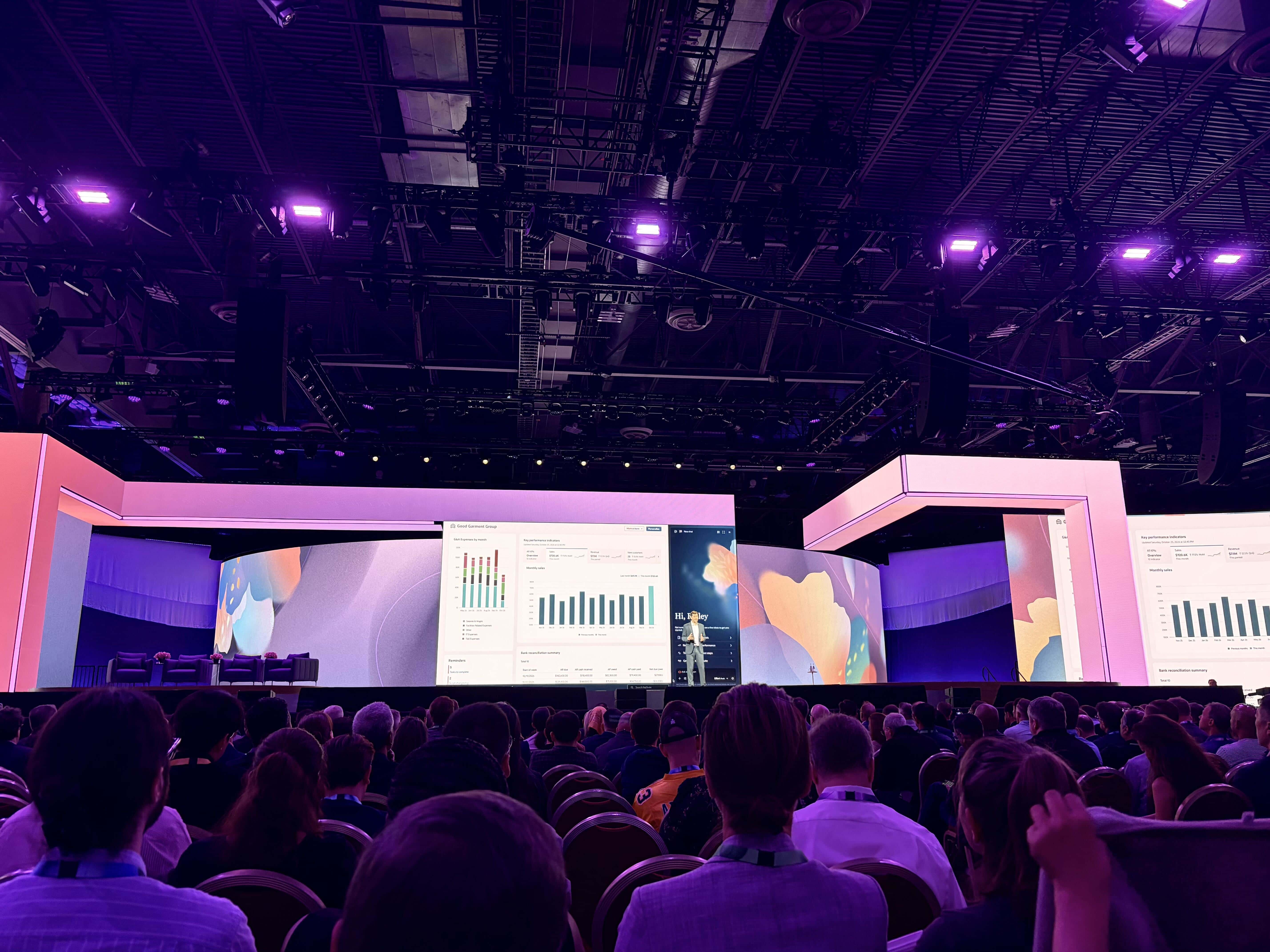
As NetSuite’s ANZ Industry Partner of the Year for 2026, Annexa team was on the ground at SuiteWorld 2026 in Las Vegas, following the keynotes, roadmap sessions and partner discussions and sharing daily recaps of the major announcements.
More than 45 SuiteSkills were unveiled during the week, alongside industry-specific SuiteAgents, AI workspaces, agent development and management tools and predictive capabilities within Ask Oracle.
NetSuite also introduced SuiteExpress, its new AI-led implementation approach. As the week progressed, conversations shifted from the announcements themselves to the practicalities of adoption. NetSuite customers wanted to know which capabilities would deliver results first, what they could start using today and how quickly the rest of the roadmap would make its way into everyday operations.
NetSuite reported that more than 15,000 customers, roughly one in three of its customer base, are now using AI across the platform, describing it as the fastest-adopted technology in the company’s history, and shared that AI Connector usage has grown from fewer than 1,000 users at launch in late 2025 to more than 13,000 by October 2026. Many of the foundational pieces are already available to Australian and New Zealand organisations or arriving in the next year.
Investment in AI capabilities
“We went to Las Vegas expecting significant investment in native AI capabilities, and NetSuite certainly delivered that. The more telling development was seeing SuiteSkills and the broader agent ecosystem built to work with external AI platforms as well as NetSuite’s own,” said Annexa’s Director, Matthew Owens.
For years, software vendors have tried to pull customers deeper into a single ecosystem. SuiteWorld pointed towards a different future, one in which businesses move between AI assistants depending on the task and the ERP provides the operational and financial context behind each interaction. It is a recognition that no single AI platform will do everything, that most businesses will end up with several AI tools and agents working across different systems, and that NetSuite’s role in that picture is to remain the critical source of business data and transactions.
Ask Oracle as first point of entry
For most organisations, Ask Oracle is likely to be the first point of entry as NetSuite Next and Ask Oracle begin rolling out. The barrier to entry is low, because people can start asking questions about their business and generating insights without changing the processes they already run.
The strongest interest from finance teams is likely to come from another area entirely. Throughout the week the financial close ran through demonstrations and roadmap sessions, with flux analysis, reconciliations, close management, payment approvals and exception handling reflecting a broader push to reduce the effort involved in recurring operational processes.
Many finance teams still rely on spreadsheets, offline processes or third-party tools to manage parts of the close, and we expect Intelligent Close Manager to be an instant adoption for the many customers who currently work around the platform’s close limitations that way.
What happens ‘after the AI prompt’
NetSuite described the adoption path during SuiteWorld as a steady progression in which organisations start by asking questions, move on to recommendations and guided actions, and allow greater automation only as confidence develops, and we expect that pattern to hold over the next two years, with customers most cautious about letting agents execute transactions and make decisions on their own.
ERP platforms have traditionally required users to navigate menus, forms and transactions to complete their work, and that gradual shift in trust has broader implications for how people will interact with them. What emerged from SuiteWorld was a picture of systems taking on more responsibility for coordinating activity, presenting recommendations and carrying out approved actions.
‘Who is doing what’ by end of 2027
By the end of 2027 we expect a growing share of the work that people now do through screens and forms to be performed by AI agents. People will be managing exceptions, approving decisions and overseeing automated processes, rather than executing every step by hand. ERP will keep running the business through that change, increasingly as the engine works in the background rather than the interface employees spend their entire day in.
SuiteExpress, NetSuite’s AI-led implementation toolset that captures requirements, migrates data and recommends configuration from a customer’s own documents and data, will undoubtedly change how projects are delivered, with documentation, analysis and configuration becoming faster and increasingly automated.
AI and the changing economics of ERP implementation
AI will significantly change the economics of ERP implementation, and that is something partners need to embrace rather than resist. We should stop measuring our value by the hours spent configuring systems, writing code and performing repetitive implementation tasks. Instead, we need to spend more of our time understanding how our customers’ businesses operate, challenging existing processes and identifying where technology can improve outcomes.
Deep industry expertise also becomes more important in that model, because knowing the right questions to ask and recognising problems before they happen are what experienced consultants bring, and implementing a poor process twice as fast still leaves a poor process.
Who will win in the age of AI?
The organisations likely to gain the most from AI are not necessarily those with the latest tools. Process documentation, data quality, approvals, governance and operational discipline remain central to success, and none of them can be bought from a vendor. The pace of product development reinforces that. NetSuite is moving towards more frequent releases, which turns implementation from a one-off project into continuous improvement in how a business uses the platform.
The biggest change for finance and operations teams is learning to move from performing work to supervising it. We have spent decades training people to operate software, follow procedures and process transactions and increasingly they will need to define outcomes, instruct agents, validate results and handle exceptions.
The habit to unlearn is the idea that having a person manually touch every transaction is the best form of control, because good governance comes from the right rules, approvals, audit trails and exception management rather than from manual processing. Teams also need to challenge why certain processes exist at all, since the biggest gains from AI will come from eliminating unnecessary steps altogether, well ahead of anything gained by making existing processes faster.
Practitioner tips for CFOs and ops leaders
For CFOs and operations leaders the practical advice is to treat AI as an operational improvement opportunity rather than another technology initiative. Look at where people are spending their time, which processes are repetitive, where the bottlenecks sit and where information is being moved between spreadsheets, emails and the ERP. You can then pick one or two of those processes, establish what they currently cost the business and run a controlled pilot to see what is possible.
At the same time, make sure data, permissions and approval processes are in good shape, because AI can automate work very quickly and that only helps when it is working with the right information and controls. There is every reason to start before the full set of announced capabilities arrives in Australia and New Zealand.
Annexa’s advice: prepare now for the next wave of AI
“Use the next six months to get your house in order,” Owens said. “With AI moving this fast, having your core platforms and data organised and secure means you can move quickly and take advantage of the latest models as they arrive, rather than being locked into one. Most teams in Australia and New Zealand are running lean, so that head start is going to be hard for anyone else to catch.”
Annexa is an Oracle NetSuite implementation and AI systems integration partner and NetSuite’s ANZ Industry Partner of the Year for 2026, with offices in Melbourne, Sydney, Brisbane and Auckland. Jarred Spriggs, Matthew Owens, Bart Wadley and Isabel Ford attended SuiteWorld 2026 in Las Vegas.
About Annexa
Annexa is a high-performing NetSuite solution provider and AI systems integration partner supporting mid-market and enterprise organisations across Australia and New Zealand. The company brings deep experience across AI, finance, multi-entity operations, supply chain, eCommerce and advanced integration, delivering connected AI-powered ERP solutions that improve visibility, lift performance and create scalable foundations for growth. Find out more visit https://annexa.com.au/