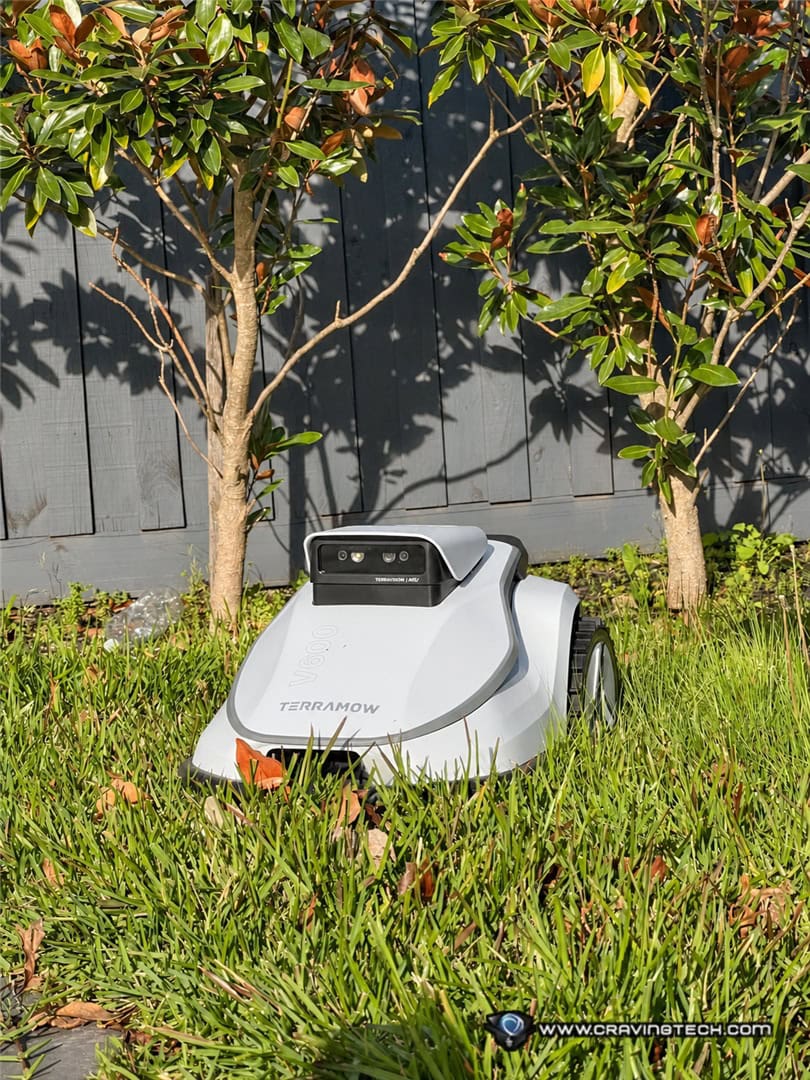
The TerraMow V600 robotic lawn mower promises to make lawn maintenance easier with AI-powered navigation, automatic mapping, and the ability to mow your lawn without requiring traditional boundary wires or an external RTK antenna. Designed for lawns of up to 600 square metres, it uses a triple-camera system to understand its surroundings and navigate around obstacles.
The idea of having a robot take care of the lawn sounds really good because this is a mundane, boring, repetitive, chore.
In our household, we aren’t particularly enthusiastic about gardening. With a toddler to look after and plenty of other things to do, maintaining the lawn isn’t exactly high on our priority list. In fact, before testing the TerraMow V600, we had let our grass grow considerably taller than it should have.
The real question, however, is whether a robotic lawn mower can handle a garden with multiple lawn areas, uneven surfaces, and stepping stones, or whether you’ll still need to do plenty of manual work.
After putting the TerraMow V600 through its paces, I found plenty to like about it, although there are some important limitations to understand before spending close to A$2,000 on one.
TerraMow V600 Review – Packaging Contents and Unboxing
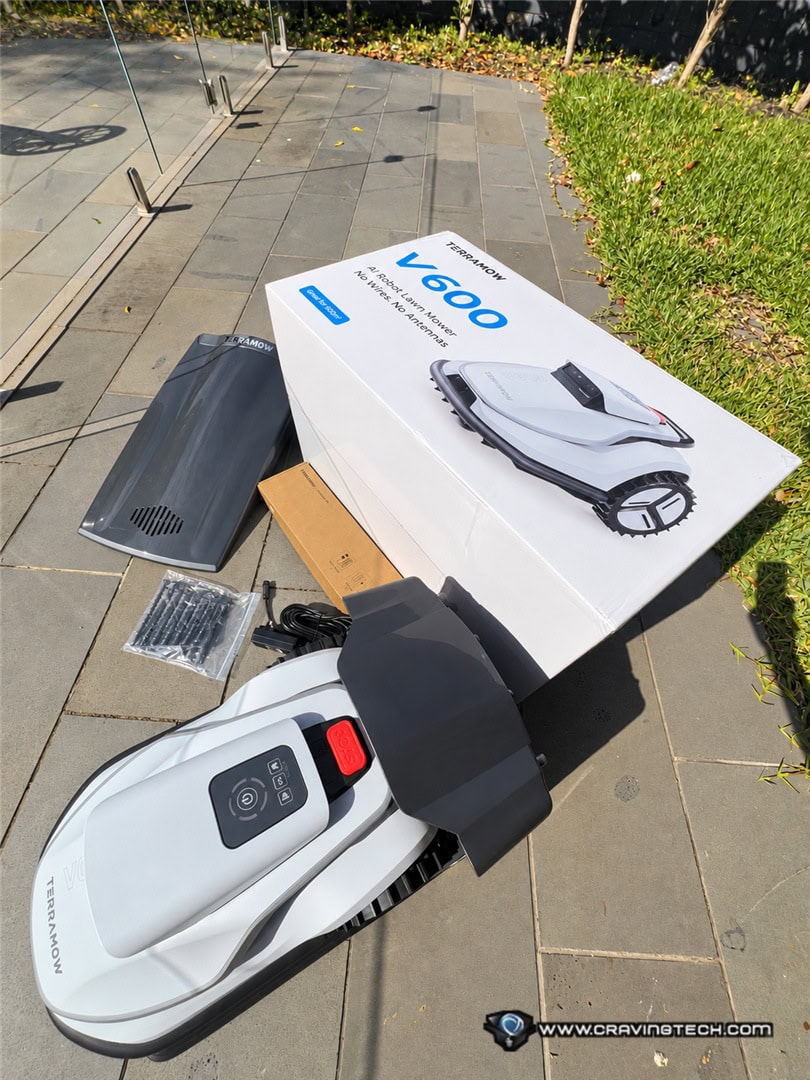
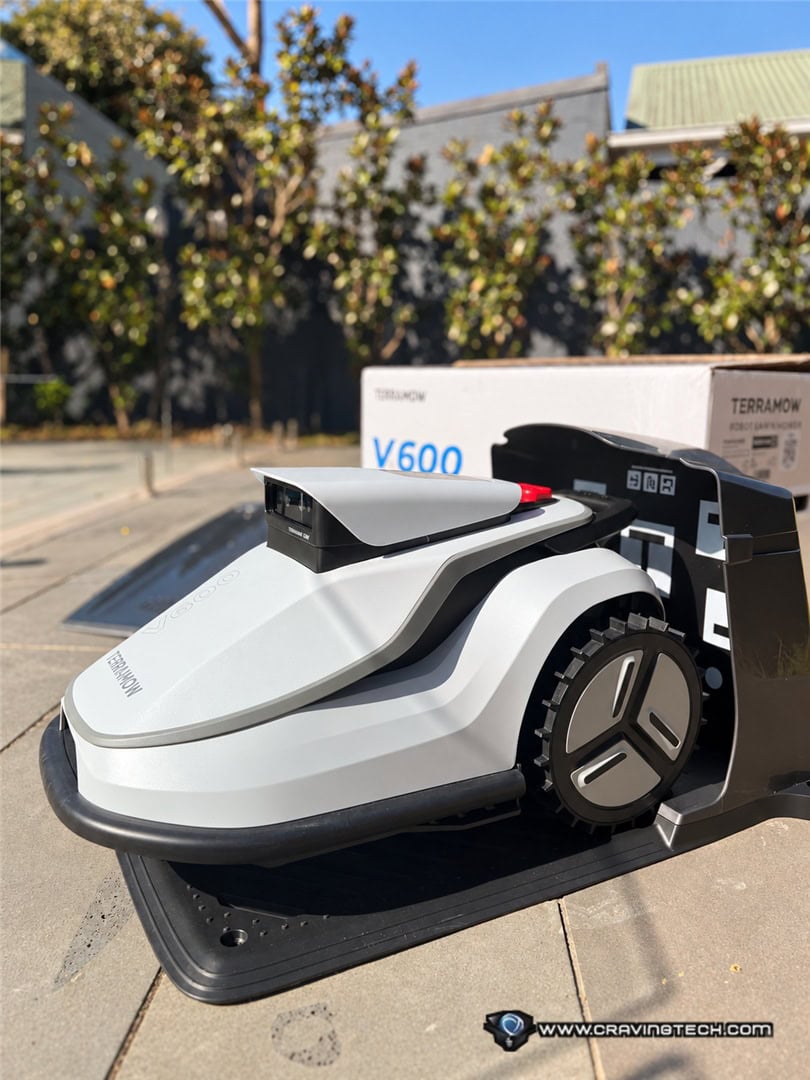
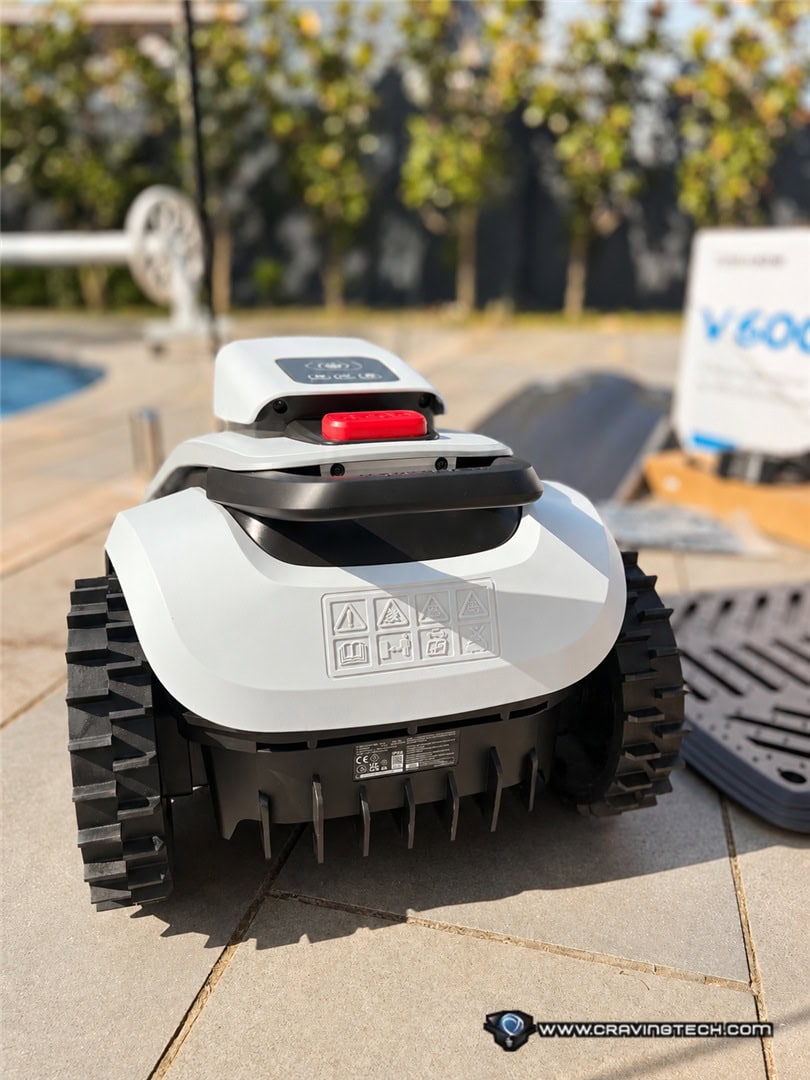
The TerraMow V600 comes with the robotic mower itself, a charging base station with a protective garage roof, power adapter, a blade kit containing nine blades, base station screws, a user manual, and a quick start guide.
It’s good to see TerraMow including a proper protective roof for the charging station. While the robot is designed to withstand outdoor conditions, having additional protection when it is docked is certainly welcome.
The included documentation is also quite straightforward, which makes the initial setup less intimidating, especially if this is your first robotic lawn mower.
TerraMow V600 Review – Design and Features
My first impression of the TerraMow V600 was very positive. It has a futuristic, sleek, and clean design that looks more like an advanced piece of technology than a traditional lawn mower. More importantly, it feels properly built. The exterior construction feels sturdy, and the wheels are thick and substantial.
The downside to all that solid construction is its weight. At approximately 11.8kg, the TerraMow V600 is quite heavy. This is worth considering because if the robot gets stuck somewhere in your garden and you need to carry it back to its base station, it can be quite an effort.
The V600 features a 203mm cutting width and an electronically adjustable cutting height ranging from 25mm to 75mm. You can change the cutting height directly through the app, which is convenient because you don’t have to manually adjust the mechanism underneath the robot.
At the heart of the V600 is TerraMow’s TerraVision 2.0 system, which uses three cameras and AI-powered visual processing to identify grass, lawn boundaries, pathways, and obstacles. Unlike robotic lawn mowers that depend on boundary wires or RTK satellite positioning systems, the V600 relies primarily on what its cameras can see.
This makes installation simpler because you don’t need to bury wires around the garden or install an external positioning antenna.
The robot also supports Wi-Fi and 4G connectivity, automatic recharging, rain detection, and over-the-air firmware updates. TerraMow rates it for slopes up to 18 degrees, while its IPX6 water-resistance rating means the mower is designed to withstand exposure to rain and water jets.
However, because navigation depends on its cameras, the robot needs adequate natural light to operate reliably. It’s not something you can simply send out at midnight like a robot vacuum cleaner.
Another important point is that the V600 is primarily designed for regular lawn maintenance, not clearing an overgrown garden. If your grass has grown beyond approximately 9cm, you may need to trim it manually before allowing the robot to take over. Tall grass can obstruct the cameras’ view, confuse lawn boundary detection, and potentially clog the cutting mechanism.
Unlike a conventional lawn mower, the V600 doesn’t have a grass catcher either. Instead, it leaves small grass clippings on the lawn, where they can gradually break down. That’s perfectly reasonable for regular maintenance, but less suitable when you’re cutting large amounts of overgrown grass.
TerraMow V600 Review – Setting Up
Setting up the TerraMow V600 was surprisingly straightforward. The app has an intuitive user interface, and the instructions are easy to follow. It took me approximately five minutes to get through the initial setup.
Of course, setting up the software and finding a permanent location for the base station are two different things.
TerraMow recommends placing the charging station on a flat lawn area without slopes, stones, or steps immediately around it. This can be more challenging than it sounds, depending on your garden layout.
In our case, we haven’t decided on the ideal permanent location for the base station. We’d prefer somewhere sheltered to protect the robot from prolonged exposure to heavy rain, but none of our suitable lawn areas has that kind of natural shelter. The charging station comes with a protective roof, and the robot itself is designed for outdoor use. However, for long-term peace of mind, I’d still prefer giving an expensive piece of equipment some additional protection from the elements.
For review purposes, we decided not to screw the base station permanently into the ground. This is something I’d strongly recommend considering before purchasing the robot. Take a good look at your garden and identify where the charging station can go, whether there is a power supply nearby, and whether the robot can travel easily between that location and the areas it needs to mow.
Every garden is different, and what works perfectly for one household might not work quite as well for another.
TerraMow V600 Review – AI Mapping and Navigation
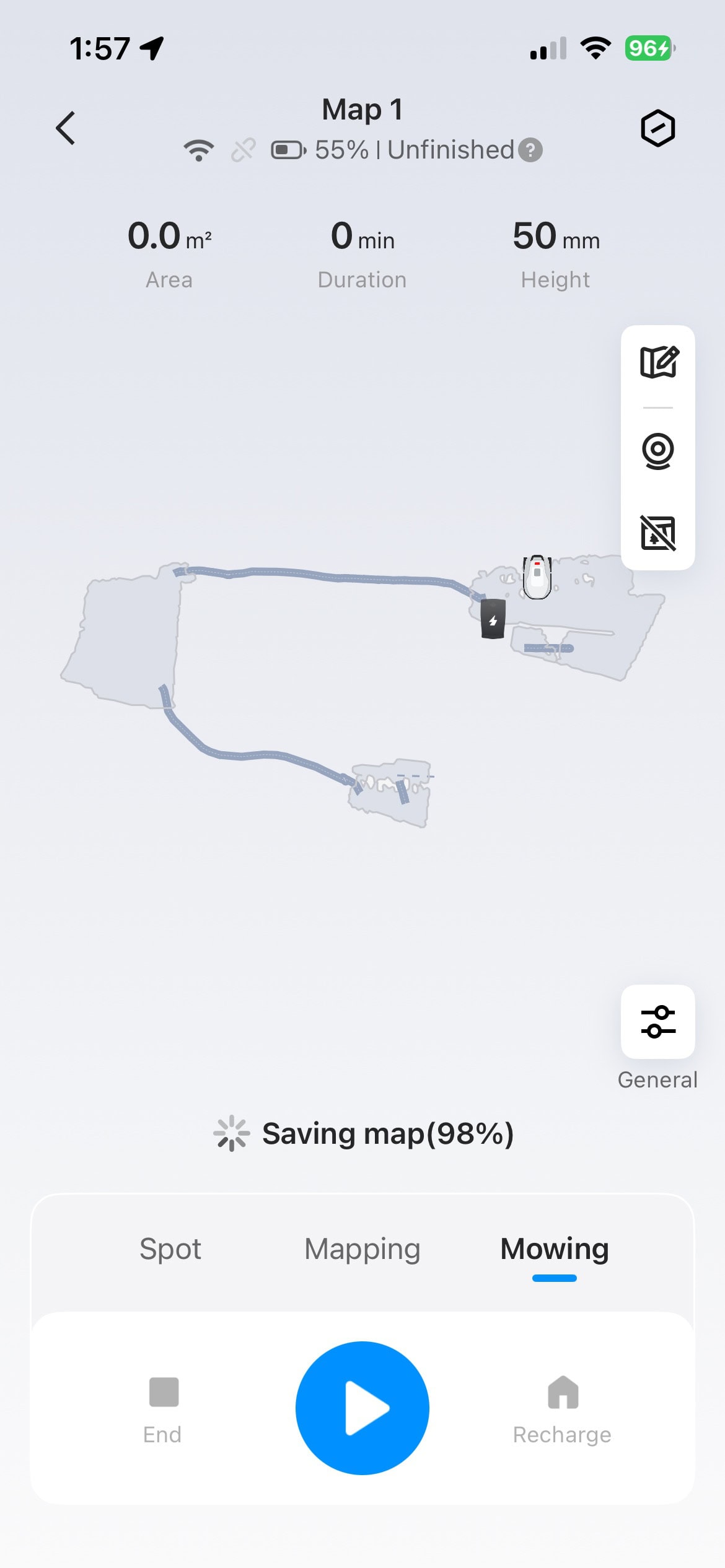
Our garden consists of three main areas: the backyard, a side lawn connecting the different sections, and the front lawn. The backyard has some raised sections, while other areas are relatively flat and straightforward.


The complexity of mapping depends heavily on your garden layout. If you have one large, flat rectangular lawn, I imagine the experience would be much simpler than dealing with several disconnected areas and uneven ground. Although I’ve used a few robot vacuum cleaners, it still took me some time to understand how best to map the garden using the TerraMow V600.
For our lawn, each area took approximately 30 to 50 minutes to map. I found this reasonably quick considering the robot was identifying the boundaries and building a navigable map of an outdoor environment. The resulting map wasn’t perfect, but I’d estimate that it captured approximately 80% of our lawn correctly. Considering the obstacles and different surfaces in our garden, I was still quite happy with the result.


Interestingly, I found its overall mapping accuracy better than that of some robot vacuum cleaners I’ve used inside the house. Of course, our garden also has fewer obstacles than our indoor living areas, which probably helps.
The robot was able to recognise raised sections of our backyard and identify areas that it shouldn’t attempt to cross. However, things became more complicated when it encountered uneven soil, stepping stones, and patches of tall grass.
Because TerraVision 2.0 relies on visual recognition, grass taller than the recommended height can sometimes be interpreted as an obstacle rather than part of the lawn. This resulted in blank patches in the generated map where the robot didn’t properly recognise certain areas.
The same problem can happen with fallen branches, fruit, and other garden debris. While the robot is designed to recognise and avoid obstacles, clearing larger debris beforehand makes its job considerably easier.
Fixing mapping problems and creating additional zones


I really like the ability to use the app as a remote control. If the robot fails to identify a particular lawn area automatically, you can manually drive it to the relevant location and create another zone. You can also establish connections between mapped areas, allowing the robot to travel from one section of the garden to another.
For example, our side lawn connects the backyard to the front lawn, but much of the connecting pathway consists of stepping stones and smaller stones. During the initial mapping process, the V600 sometimes treated a stepping stone as the end of the lawn rather than recognising that there was more grass on the other side.
Fortunately, the app provides tools to extend mapped boundaries and add new zones. This made it possible to correct some of the problems without having to start the entire mapping process again.
There are limitations, though. While I could extend an existing zone’s outer boundaries, I couldn’t simply fill in all the blank patches within a mapped area using the map editor. Some of these blank patches represented areas of grass that were too tall for the robot to recognise properly. This meant that I occasionally needed to use manual control and create additional zones instead.
The biggest surprise came when I started using the robot after completing the mapping process.
When I initially drove the V600 along the stepping-stone pathway manually, it got stuck a couple of times because of the uneven surfaces. I had to intervene and help it get moving again. However, after completing the mapping and starting a normal mowing session, the robot managed to navigate back to its charging station without getting stuck along the same pathway. So, I was quite impressed at the end.
This doesn’t necessarily mean that the robot is continuously retraining its AI model every time it cuts the lawn. Rather, having an established map and navigational information helps it follow more consistent routes and avoid previously troublesome areas.
It’s also worth noting that the V600 didn’t successfully identify the patches of grass growing between our stepping stones as areas that needed mowing. From what I observed, it generally treated the stones as a connecting pathway rather than a lawn area. The uneven height between the soil and stones probably contributed to the problem.
If you have a garden with stepping stones, particularly ones that aren’t level with the surrounding grass, this is something to keep in mind. You may still need to trim those sections manually.
TerraMow V600 Review – Mowing Performance


For my testing, I set the cutting height to 50mm.
At this height, the difference between the before-and-after photos wasn’t particularly dramatic. However, the idea behind a robotic lawn mower isn’t necessarily to transform an overgrown lawn in a single session. Instead, it’s about maintaining the grass at a consistent height without requiring you to spend your weekends mowing.
And for that purpose, the TerraMow V600 performed well. Once the lawn was properly mapped and the robot knew where to go, I could start a mowing session and leave it to do its work.
If the battery became low during a session, the V600 automatically returned to its charging station. Once it had recharged sufficiently, it resumed the remaining task without requiring me to start everything again.
According to TerraMow, the V600 can operate for approximately 120 minutes on a full charge, with a charging time of around 100 minutes. Its estimated mowing coverage is 130 to 250 square metres per charge, depending on the lawn conditions and complexity.
For larger lawns or multiple zones, the automatic charging and resuming feature is very useful. In our case, the only thing I really needed to do was make sure the gate separating the lawn areas was open so that the robot could travel between them.
After that, I could head back inside and do something else while it continued mowing.
And this is probably the biggest reason to consider buying a robotic lawn mower in the first place. You aren’t necessarily purchasing better-looking grass. You’re purchasing the convenience of not having to do the mowing yourself.
I also like the idea of scheduling mowing sessions during the afternoon, especially if your household has solar panels. You can make use of electricity generated during the day to recharge the robot, potentially reducing the cost of running it.
Edge cutting still needs work
Unfortunately, the TerraMow V600 isn’t particularly good at trimming the edges of our lawn. During automatic mowing, I noticed that it generally left some grass around the edges untouched. Even when I selected the dedicated edge-cutting feature in the app, the results weren’t quite what I hoped for.
The main issue appears to be the physical design. Because the wheels are fairly large and the cutting mechanism doesn’t extend all the way to the outer edge of the robot, it sometimes rolls over the grass along the lawn boundary without actually cutting it. As a result, the grass around the edges still needs attention with a manual trimmer.
The same applies to the grass growing between our stepping stones, which the robot didn’t identify as a mowing area. I also still need to deal with weeds and some of the more difficult sections of the garden manually.
This doesn’t necessarily make the V600 a bad robotic mower. It simply means that you shouldn’t expect it to replace every aspect of garden maintenance. It handles the repetitive task of keeping the main lawn areas trimmed, but you’ll still need to spend some time on the finer details.
TerraMow V600 Review – Price, Warranty, and Value
With an Australian price ranging from approximately A$1,799 to A$2,000, the TerraMow V600 certainly isn’t an inexpensive purchase. However, for a robotic mower designed to maintain lawns of up to 600 square metres, I think the pricing is reasonable when you consider its camera-based navigation and automatic mapping capabilities.
The V600 is available through Australian retailers, including Amazon Australia. The advertised warranty is another positive, with three years of manufacturer coverage for the mower, charging base and power adapter, while the battery carries a separate two-year warranty. As always, check the warranty conditions and the seller’s after-sales arrangements before purchasing.
For an expensive product that will spend much of its life outdoors, local warranty support is a must. The price becomes more interesting when you consider the amount of time and money you would otherwise spend maintaining your garden.
The last time we hired someone to mow our lawn and take care of the weeding, it cost us approximately A$300 to A$400. At that rate, the purchase price of the TerraMow V600 is roughly equivalent to five or six professional gardening visits, depending on what you pay.
Of course, this isn’t a direct comparison. A professional gardener typically does more than just mow the grass, while the robot won’t handle weeding, detailed edge trimming, or other gardening work. You’ll also have to account for electricity, replacement blades, and maintenance over time.
But if you’re happy to do some occasional trimming and weeding yourself, using a robotic mower for the regular mowing could potentially save a considerable amount of money in the long run. More importantly, it gives you back time that would otherwise be spent pushing a lawn mower around the garden.
And for our family, that’s arguably the most valuable part of owning one so we can have more time playing with our toddler or do other, more important tasks.
TerraMow V600 Review Conclusion

The TerraMow V600 robotic lawn mower has made me appreciate just how useful automated garden maintenance can be, especially for a busy household that doesn’t particularly enjoy gardening.
Its build quality is excellent, the app is easy to use, and the AI mapping system does a reasonably good job of understanding a garden with multiple areas. I also appreciate how the robot can automatically return to its charging station and resume mowing without much intervention.
The fact that it doesn’t require boundary wires or an external RTK antenna makes installation more approachable, and the advertised three-year warranty adds some reassurance considering the investment involved.
However, the experience isn’t completely hands-free. Mapping complicated lawn layouts can take some patience, tall grass needs to be cut beforehand, and uneven stepping stones can confuse the navigation system. Edge cutting is also an area where I’d like to see improvements. But once everything is properly configured, the convenience becomes clear.
For our family, we don’t necessarily need a perfectly manicured lawn every day. We just want to prevent the grass from growing out of control without having to constantly think about mowing it.
The TerraMow V600 does a good job of that. We can let the robot handle regular mowing, then spend some time every few months trimming the edges, removing weeds, and tidying up the more difficult areas.
If you enjoy gardening and want every corner of your lawn looking immaculate, you might find the limitations a bit of a let down. But if you’re a busy household looking to reduce the amount of time spent on garden maintenance, the TerraMow V600 is certainly worth considering.
It won’t eliminate gardening completely, but it can take one of the most repetitive jobs off your hands.
Black Friday & Cyber Monday Exclusive Offers from ADVINSYS
Black Friday and Cyber Monday are just around the corner. If you’re thinking about upgrading your lawn care routine, ADVINSYS has put together an exclusive offer for Craving Tech readers.
TerraMow V600: https://dada.link/Pdmy4g
Amazon Original Price: A$2,199.99
Auto coupon discount at Amazon checkout: A$500 off
Exclusive Craving Tech reader discount: A$100 off with promo code CTECHV600
Final Price for Craving Tech readers: A$1,599.99
TerraMow V1000: https://dada.link/4SxInk
Amazon Original Price: A$2,499.99
Auto coupon discount at Amazon checkout: A$400 off
Exclusive Craving Tech reader discount: A$100 off with promo code CTECHV1000
Final Price for Craving Tech readers: A$1,999.99
About ADVINSYS
ADVINSYS specialises in smart outdoor solutions designed for Australian homes and lifestyles. The company is the Australian distributor for the TerraMow V600 and V1000 robotic lawn mowers, as well as iGarden’s full product range—from robotic pool cleaners and heat pumps to portable swim jets. By bringing together innovative solutions across lawn care, pool maintenance and outdoor living, ADVINSYS helps Australians spend less time on maintenance and more time enjoying their outdoor spaces.
Website: https://www.advinsys.com.au
Disclosure: TerraMow V600 review unit was supplied for reviewing
TerraMow V600 Review
Overall
Summary
Make your lawn looking immaculate every day without lifting a finger, thanks to TerraMow V600
Pros
- Solid build quality with a sleek, futuristic design
- Easy initial setup and well-designed mobile app
- No boundary wires or external RTK antenna required
- Good automatic mapping with convenient manual zone controls
- Automatically returns to charge and resumes mowing
- Handles regular lawn maintenance with minimal intervention
- Protective charging station roof included
- Advertised three-year mower warranty
Cons
- Heavy at 11.8kg if manual lifting is required
- Uneven stepping stones and tall grass can confuse navigation
- Edge cutting leaves grass that still needs manual trimming
- Requires suitable base station placement and adequate daylight